







Recent posts

TAG Heuer Connected Calibre E5


Hidden Gem


Recent Comments

I'm not exactly sure what more you want to know 😕
If you're asking about quartz technology, the Omega caliber 1538 used in these watches is pretty good, especially for its time, but it's certainly not as advanced as you'd find, for example, in today's top-of-the-line Citizen.
As to the specific features of the 1538 (or, equivalently, the ETA 255.461 on which it is based), here's my attempt at an explanation:
Inhibition Compensation: The natural vibration frequency of quartz depends on how the crystal is cut. In cheaper watches, that's the extent of the timing regulation: cut the crystal so as to get a desired vibration frequency and base the movement timing on the assumption that you've cut the crystal correctly. The challenge is cutting precisely enough to get that exact frequency. The 1538 takes a more sophisticated approach. The crystal is cut so that the natural frequency is a bit faster than desired, generally around 4 seconds/day too fast. But it doesn't have to be super precise. Once a crystal is installed in the movement, the actual crystal frequency is then precisely measured for that movement in the factory. The factory then programs each specific movement with a compensation factor to account for actual frequency of its crystal. The programming causes the watch to slow down (inhibit) periodically; in the case of the 1538, inhibition happens every 60 seconds. So if the crystal is cut at 4 s/d too fast, the second hand will advance 59 times every 0.9999537... seconds and then one time after 1.00273896... seconds. The result is a movement whose timing is precisely matched to the crystal installed in it.
Pulse Width: When the movement does engage the stepper motor to advance the second hand, it doesn't do so for an entire second. Rather, the movement turns on the motor for a brief period within each second. The pulse period for the 1538 is about 7.8 millseconds. For the rest of the period (i.e. 992.2 ms), there is no force applied to the motor. This is the main reason that quartz movements need very little service. They are only applying force to the gears for about 0.8 % of the time. Compare that to a mechanical movement, which is exerting force on the gears 100.0 % of the time. It's not quite this simple, but if you consider that a mechanical movement needs service every 5 years, then the 1538 quartz movement would take 641 years to experience the same amount of wear. This is also why modern quartz movements are so parsimonious in their battery consumption: they're not really using any power at all 99.2 % of the time.
Asservissement: Cheap quartz movements simply energize the stepper motor every second and just assume everything works. As you might have guessed, the 1538 is more sophisticated. Not only does it energize the stepper motor, but it also senses the second hand vibration. So it can tell if the hand actually moved like it was supposed to. It uses these measurements to tweak how the pulse is applied to the motor. The 7.8 millisecond stepper motor pulse is not a constant, uniform application. Rather, the movement rapidly switches the motor on and off during that 7.8 millisecond interval. Normally the motor is on for about half the time (i.e. 3.9 ms) and off for about half the time (also 3.9 ms). As long as the hand is moving, everything is fine. But if something (e.g. a speck of dust in one of the gears) impedes the hand so that it doesn't advance correctly, the movement will detect that from the lack of vibration. In the next pulse, it will increase the percentage of time that the motor is on. So it may, for example, turn the motor on for 5 ms and off for 2.8 ms. (Again, these are rapid on-off switches during the 7.8ms.) This has the effect of applying more power to the motor, kind of like pushing down on the accelerator when you're driving up a hill. If that still doesn't advance the second hand, the movement will increase the on percentage even further. It will keep doing that until it suceeds in getting the hand to advance, and then it will back off to return to the half on / half off duty cycle. Obviously, there are limits, but this process can usually allow the movement to deal with any minor mechanical issues. In can certainly cope with imperfections caused by our hypothetical dust speck. The successful motion will also likely dislodge that dust speck so the movement won't have to deal with it next time around.
I like mechanical movements as much as any watch geek, and I own more mechanical watches than quartz watches, but I think quartz technology is pretty cool as well. (And don't get me started on the absolutely bonkers stuff that Grand Seiko and Citizen do in their super high end quartz movements.)
I own a couple: a Seamaster 120m from 1993 and a Seamaster Professional from 1998. Both are still running fine today with no maintenance other than a battery change.
Omega's quartz movements are, indeed, just ETA movements with fancy decoration, but the base ETA movement is considerably more complex than what you'd find in a $10 Walmart watch. It uses inhibition compensation to precisely tune the timing (every 60 seconds), a short pulse width (< 8 ms) to minimize battery consumption, and asservissement to compensate for mechanical wear.

Not a chance. Swatch for sure won't sell you a case, and if a local watchmaker with access to Longines parts did it for you, Swatch could very well cut off their access to all OEM parts in the future.
Only if "reasonable" includes purchasing both. A local watchmaker could swap the dials no problem. You could then try to sell the unwanted dial/case combo as a used watch, but since it wouldn't be an original release, you'd take quite a bath on the sale.
They actually haven't released it yet, other than a handful of demos sold in person in New York. When it's available, the blue limited edition has an even stronger Pole Router vibe in my opinion (though I prefer the white dial).

More posts
Erika's Original on Apple Watch Ultra


Benrus vs. Longines


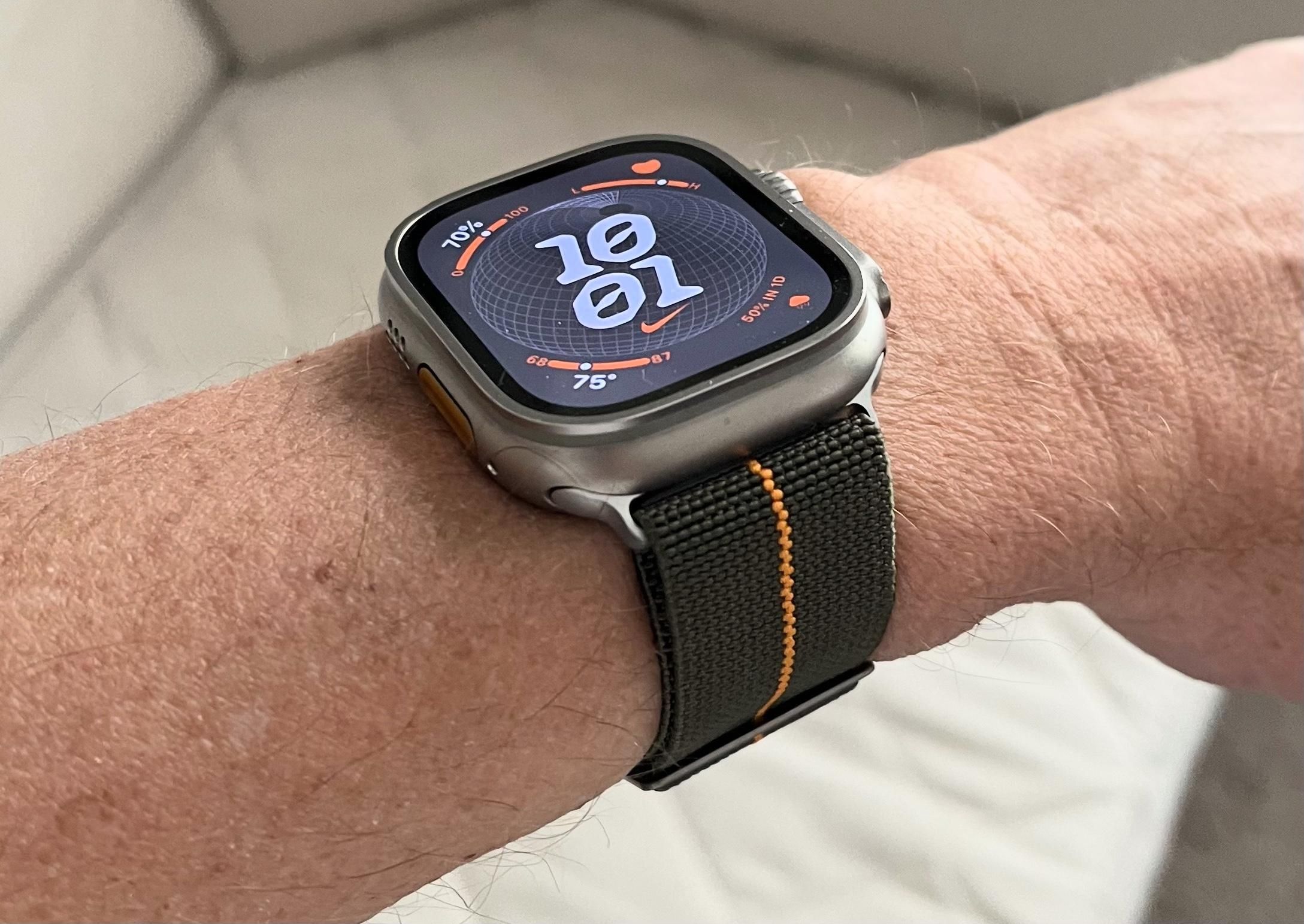
An Opinionated Guide to the Ultimate Apple Watch Ultra Band


Building My Own Watch


Blue Divers Smaller Than 38mm


Tool watch trilogy




