Seiko 6R35 Movement

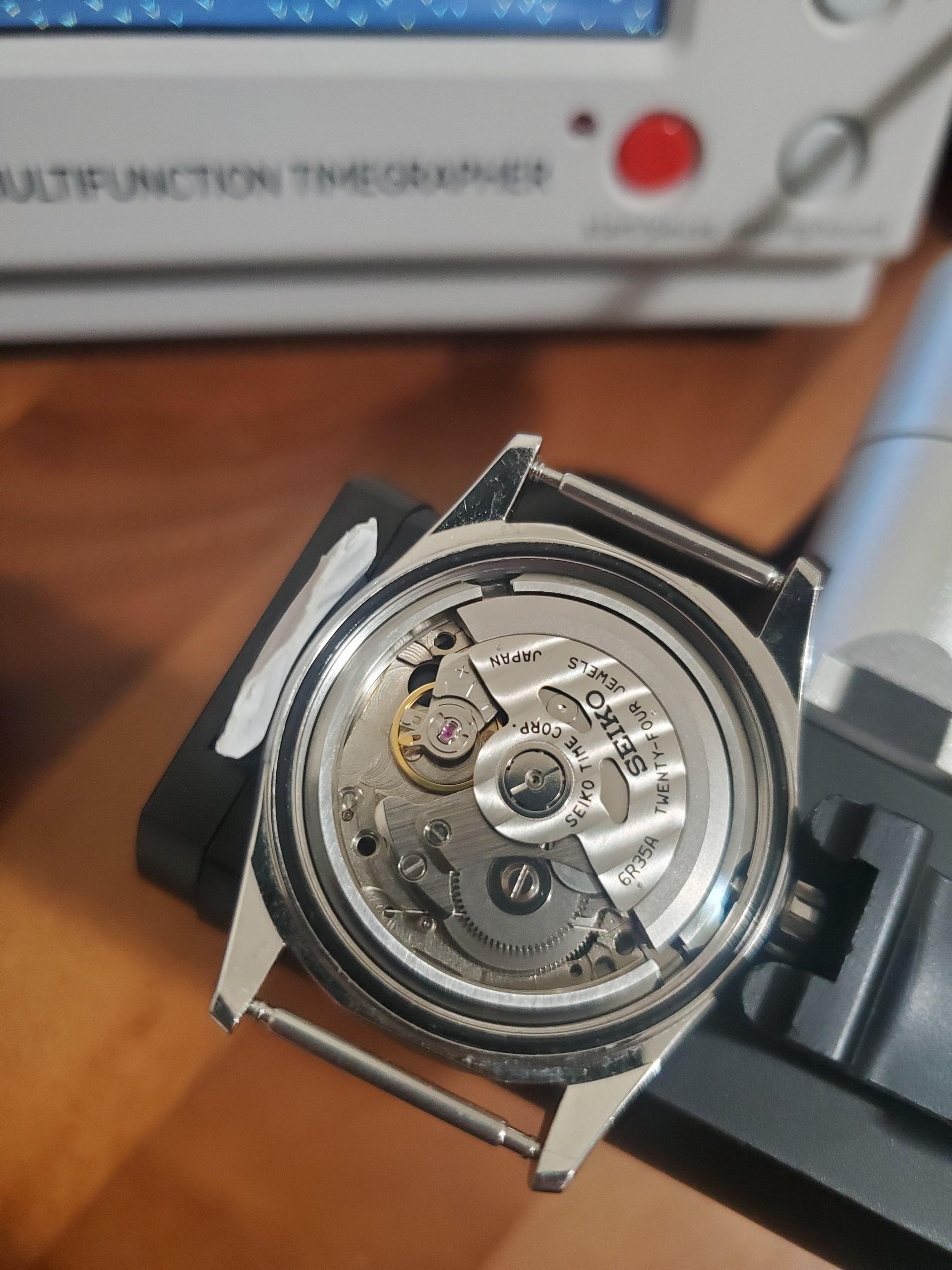
I’ve been wearing an automatic Seiko with the 6R35 movement, which the manual rates at –15 to +20 seconds per day. I wear it daily, but my lifestyle isn’t very active, and it consistently loses about 15 seconds each day.
I’m curious to hear your thoughts. Have you experienced similar accuracy with your automatic watches? What level of daily deviation do you consider acceptable? And how often do you find yourself manually winding your watch or adjusting the time?
Would love to hear your experiences!
70 comments
Sort by




Who cares if its loosing 5 sec to 60 sec a day.I like it if it works for the day then I move to next watch in my collection. For time check its always the mobile to fall back on🤣
I have the alpinist with the same movement, but never meseaured it. Still cool.
Btw which watch is urs?
I don't really care about the accuracy. Unless it's a new watch, then I expect it to run according to the specs. For accuracy I use my smartphone.
Btw which watch is urs?
SPB241
The 6R35 on my Baby Alpinist is +6 seconds a day and I rest the watch with the dial face up. I don't really bother with accuracy on automatic movements anymore. Waste of time.
My 6R35 Alpinist has been frustrating. It ran very nicely on average, about +6 s/d if I didn't change the resting position, but the positional variance was huge, sometimes more than a minute. I basically never had to touch the crown, I just rested it one way or another and it would remain on time indefinitely.
Someone suggested it might be magnetised, so tried for a warranty repair. They found no magnetisation and now the watch runs -30 s/d, with the positional variance unchanged. So it got demoted from a main watch, worn almost half the time, to the first among equals in the rotation.
I'll try to have it regulated upon the next service. I have considered selling it for a Traska or something, but the Alpinist is so unique and full of charm, I hope to keep it for a long time, but I'm never buying a 6R Seiko again.
The 6r is known for variability from the factory especially if left dial up. You can get lucky, I recently measured mine over a week vs a “rcvd” 5610 with 5.5 seconds over the week, yes week, worn 24/7.
I have nearly stopped wearing autos, as they simply stop. Instead Im now mainly wearing manual wind watches, they dont stop, they are (relatively...) precise - and I love the daily interaction. I did buy a Sinn U15 recently, and it has stopped on my frequently already.
When wearing an auto, and make sure to "shuffle" it for a while, every evening.
The 6R35 is notorious for being all over the place, timekeeping wise.
If you get a good one, it can be really good. If you get a bad one (I’ve got a couple) it can be next to impossible to regulate.
It’s one of the few movements that would actually put me off buying a watch; and I don’t consider myself a movement snob by any means
I guess it’s not as simple as just tapping the regulator towards the plus sign? Can the watch be regulated better?
The 6R35 is notorious for being all over the place, timekeeping wise.
If you get a good one, it can be really good. If you get a bad one (I’ve got a couple) it can be next to impossible to regulate.
It’s one of the few movements that would actually put me off buying a watch; and I don’t consider myself a movement snob by any means
Which movement do you suggest?
Which movement do you suggest?
I’d go for a Miyota 9000 series over a 6R35 any day.
Honestly, I’d go for a 4R35 over the 6R35
6R35 movement is actually a decent movement
Most people who buy seiko’s really don’t care about accuracy and get incredibly butthurt when you criticise them.
For me- I really care. Even if I was living a more relaxed slower pace of life I still want to know what the time is accurately.
So if I ever want another watch at that 500 or under price point it’ll be a solar quartz.
A watch that runs +\- 25 or 30 seconds a day is tbh and imho useless.
You can have you Seiko movements regulated to better accuracy
Yeah I had my Gene Kranz warranty voided from +35/day to +5 for £20 😂😂
I still don’t wear it because I know it’s gonna run away in whatever resting position and I can’t be arsed having to hack it daily 😂
I really think that outside of +/- 15 or 20 sec per day shouldn’t be acceptable from a mid level Seiko. I have adjusted most of my seikos to run inside of 15 per day.
I see a lot of people defending Seiko on their inaccuracy/ lack of regulation, but it’s the only brand from my experience where you can spend give or take a thousand bucks on a new watch and more than likely get a fairly inaccurate movement. Every other $750+ brand new watch I’ve purchased has run inside of 10 sec/ day. If a micro brand can do it, I feel like Seiko should be able to as well. (Seiko lover here.. I love what they do otherwise)
Yeah but you might be lucky and be the 1 in 15 or 20 sold that runs at cosc spec - everything else basically inaccurate and not fit for purpose
We agree
I guess it’s not as simple as just tapping the regulator towards the plus sign? Can the watch be regulated better?
It is pretty simple to regulate these movements, especially when you have a Timegrapher. It is fiddly, and decidedly non-linear, but very doable with a simple toothpick.
I don't have a problem with watches that are inaccurate as long as they are consistent, I do have a problem with watches that have large positional variance.
If not vintage it must perform within declared specs, period. I sold the Alpinist after app. 2 years, maily due to some QC issues and movement accuracy which was still not within (too) widely defined specs after being regulated at AD for 2 times. Heard both cases oftenly with 6R35, meaning being quite accurate or off a lot
I have the 6R in my alpinist and, knock on wood, so far it has been good (only been a couple months).
Watch started running about +15 sec/day but “settled in” after about a week of regular wear.
Now runs about +3 sec/day. And I have found similar to other comments in that depending on the position I rest it in overnight, it runs slightly fast or slightly slow.
All my autos currently run +/-3 sec/day which I am very content with.
Which resting position gets your watch to about +3 spd?
Every automatic watch gains or loose time depending upon movement.It is acceptable in the range of +- 15 seconds per day...as many watch brands mention this range.Some watch brands even mention this range upto 40 seconds per day.If you need more accurate automatic watch, you need to go for certified chronometer watch which generally costs more than 1000$.I have read lot of articles regarding automatic watch accuracy and tried lot of things on my automatic watches also.Putting some points with regards to my study.
1.Automatic watch accuracy depends on many factors such as temperature, position of watch in which it's being hold on your wrist.
2.Generally watches in the range of 100 to 500 $ are considered to have deviation in the range of +-20s/d.Even you will get some chronometer watches in the range of 500 to 700$...but some high end watch brands which use certified chronometer as default have perfect accuracy of +-2s/d....Omega, Rolex and Breitling are in this category.So if you need perfect watch over long period of time you have to pay more.
3.Chronometer is a accuracy certificate given to movement after doing lot of tests in different positions and calculating deviation of time for each position.Doing all these tests they try to maintain time deviation of that particular movement in the range of +-2s/d.
4. I have my certified chronometer Tissot and it also loose time between 10-15 s/d.As this watch is equipped with highly sensitive selenium spring..it's very sensitive to temperature and wearing positions..sometimes it shows time very accurate in the range of +-2s/d.
I think because of uncertainty in climatic conditions now a days ...watches are getting affected 😃.
That was such a clear and valuable explanation. I really appreciate the time you took to explain it
Which resting position gets your watch to about +3 spd?
Yes good question
Which resting position gets your watch to about +3 spd?
Wearing it all day typically results in +3-4 secs.
This typically results in 0 to +3 secs
This one typically results in -3-4 secs
Wearing it all day typically results in +3-4 secs.
This typically results in 0 to +3 secs
This one typically results in -3-4 secs
Could you please take a clear shot of +3 sec position?
Could you please take a clear shot of +3 sec position?