Watches Beyond: The Deepest

Hi everybody,
welcome to the second installment of the Watches Beyond series in which I introduce you to timepieces that push the boundaries of watchmaking.
Today, our topic will be everybody's darling, dive watches. Not just any dive watches, however, but those that have achieved the highest depth ratings, going deeper than any human being and even most modern submersibles could go.
Please enjoy while we venture into the depths! 🤿
Side notes:
The depth information provided here may vary depending on source.
To be granted a specific depth rating according to ISO 6425, a watch must be able to withstand the specified depth for two hours. After this, it must be able to withstand a depth of three metres for three hours in order to simulate the effects of ascent. And it must also be able to withstand 125% of the pressure at the specified depth.
Buyers advice: the watches shown might not fit under a dress cuff anymore.
≥0 m: EPIPELAGIC
≤18 m: Recreational diving depth (PADI)
18-30 m: Recreational deep diving depth (PADI)
≥60 m: Technial diving depth (PADI)
100 m: ISO 6425 dive watch minimum depth rating requirement
A look into the past:
73 m: Omega Marine (1932)

91 m: Blancpain Fifty Fathoms (1953)

100 m: Rolex Oyster Perpertual Submariner (1953)

100 m: Zodiac Sea Wolf (1953)

Before we move on to our actual list, let's take a look at the origins of dive watches, which date back to the early 20th century. Although Rolex debuted its Oyster case as early as 1926 which British swimmer Mercedes Gleitze wore one year later during her attempt to swim the English Channel, the Omega Marine was the first commercially available purpose-built dive watch. The Marine featured a patented double case and was sealed with cork. It had a depth rating of 73 metres, which was later raised to 135 metres.
The era of modern dive watches began around 20 years later, in 1953, with the introduction of the Blancpain Fifty Fathoms (named after its depth rating), the Rolex Submariner, and the lesser-known Zodiac Sea Wolf. These watches featured increased depth ratings and rotating timing bezels, which remain a hallmark of dive watches to this day.
≥200 m: MESOPELAGIC
253 m: Human free dive record (Herbert Nitsch, 6 June 2012)
332 m: Human SCUBA dive record (Ahmed Gabr, 18/19 September 2014)
≥1,000 m: BATHYAL
2,992 m: Mammal dive record (Cuvier's beaked whale)
3,803 m: Titanic wreck
≥4,000 m: ABYSSAL
5⃣ 5th place:
5,000 m: Pita Oceana (2009)

5,000 m: Sinn UX EZM 2B Hydro (2022)

5,000 m: Delma Blue Shark IV (2023)

Although there have been many watches in the past, that featured thousand or even multiple thousands of metres of water resistance, our list starts at a depth of 5,000 metres. This depth is a lightless and hostile environment, an ideal setting to put the most extreme dive watches to the test.
Three watches tie for fifth place: The Delma Blue Shark, the Sinn UX EZM 2B Hydro, and the Pita Oceana Titanium. These manufacturers have each used different methods to achieve a high level of water resistance: the Delma has a chunky and robust steel case, the Sinn features a case filled with oil, and the Pita has magnetic gears instead of a winding crown eliminating potential weak points in the case.
≥6,000 m: HADAL
4⃣ 4th place:
6,000 m: Omega Planet Ocean Ultra Deep (2022)

The pinncale of Omega's consumer dive watches, the Planet Ocean Ultra Deep features a case crafted from O-MEGASTEEL or titanium, Omega's in-house co-axial calibre 8912, and has been tested in real ocean conditions to a depth of 6,000 metres.
10,984 m: Challenger Deep, Mariana Trench
🥉 3rd place:
11,000 m: Rolex Deep Sea Special (1953, protoype)

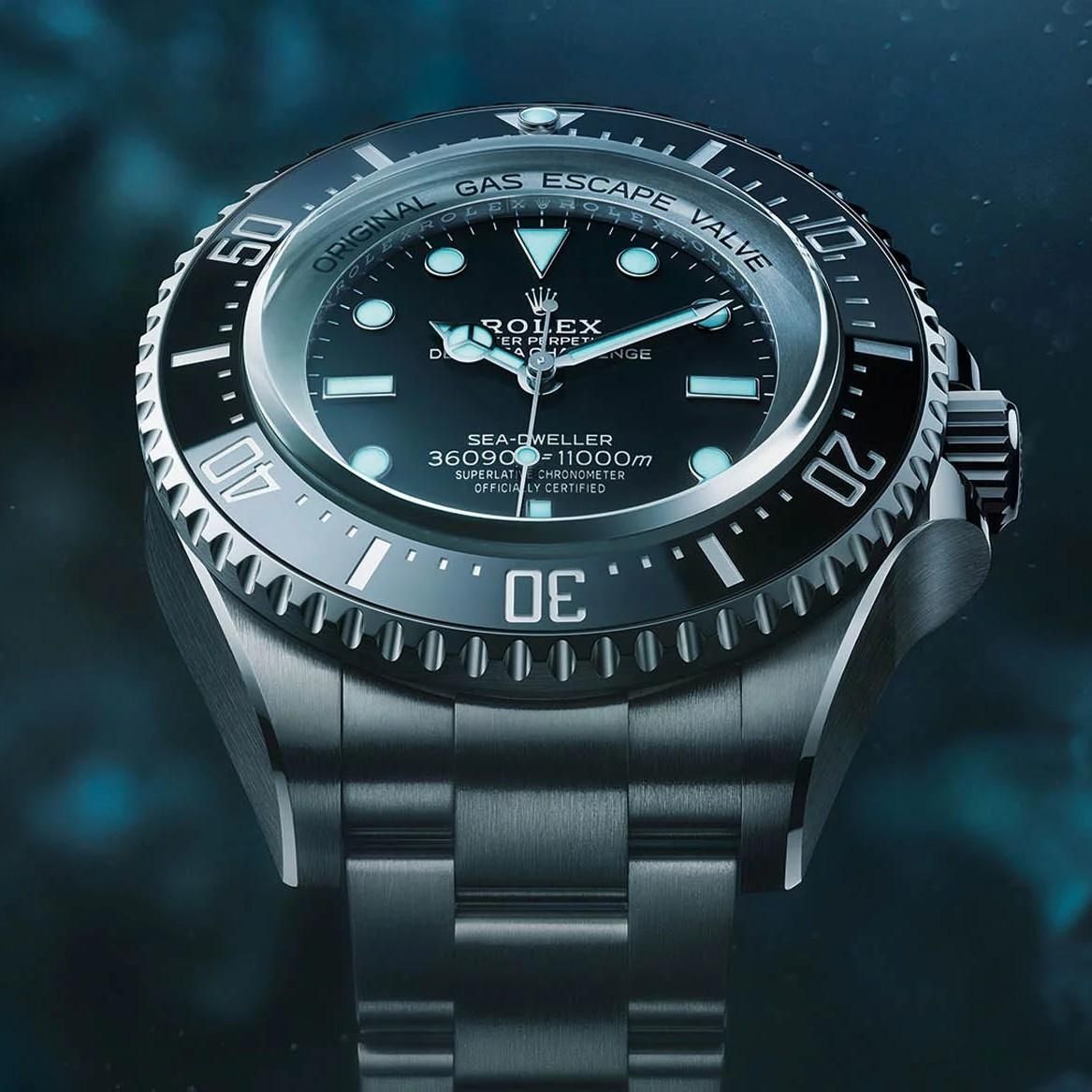
11,000 m: Rolex Deep Sea Challenge (2012)

The third place is shared by two Rolex models separated by almost sixty years:
The Rolex Deep Sea Special, introduced in the same year as the Submariner, accompanied several diving missions in the 1950s and 1960s, eventually travelling to Challenger Deep — the deepest point of the Mariana Trench — at a depth of 10,916 metres aboard the Trieste bathyscaphe on 23 January 1960. This watch was never made publicly available, although a commemorative bimetallic version was released in the mid 1960s. The Deep Sea Special No. 3, which reached the bottom of the sea, is now on display at the Smithsonian Museum.
The Rolex Deep Sea Challenge is a follow-up to the 1967 Sea-Dweller and the 2008 Deep Sea. While it boasts the same water resistance rating as the Deep Sea Special, it has more wearable dimensions, as well as a helium escape valve and Rolex's proprietary Ringlock system.
In 2012, a prototype of the Deep Sea Challenge accompanied filmmaker James Cameron on a descent to Challenger Deep, reaching a depth of 10,908 metres. The production version was made available for purchase in 2022.
🥈 2nd place:
11,100 m: Bell & Ross Hydromax (1997)

Released in 1997 by the French company Bell & Ross, the Hydromax surpasses the depth rating of the Deep Sea Special and the Deep Sea Challenge by just 100 metres. This achievement earned it a place in the Guinness Book of World Records and second place on this list. Designed and constructed by Sinn in Frankfurt, the Hydromax achieves its enormous water resistance through an oil-filled case similar to that of the UX.
🥇 1st place:
15,000 m: Omega Planet Ocean Ultra Deep Professional (2019, prototype)

On 28 April 2019, as part of the international Five Deeps Expedition, the deep-submergence vehicle Limiting Factor reached Challenge Deep at a depth of 10,927 metres, setting a new world record. To accompany this mission, Omega built three prototypes of its most ambitious dive watch to date: the Planet Ocean Ultra Deep Professional. These were fixed to the outside of the vessel, as well as to one landing unit. The Planet Ocean Ultra Deep Professional features a full titanium case measuring 52.5 mm in width and 28 mm in height, a 9.5 mm thick sapphire crystal, and an astonishing depth rating of 15,000 metres!

👨31-year old mechanical watch enthusiast based in Germany ♥️ Mid-sized, monochrome watches 💔 Hommages, Fauxtina, C3 Super-LumiNova, non-quickadjustable bracelets



Great post, good read! Well done! 👑