




Recent posts

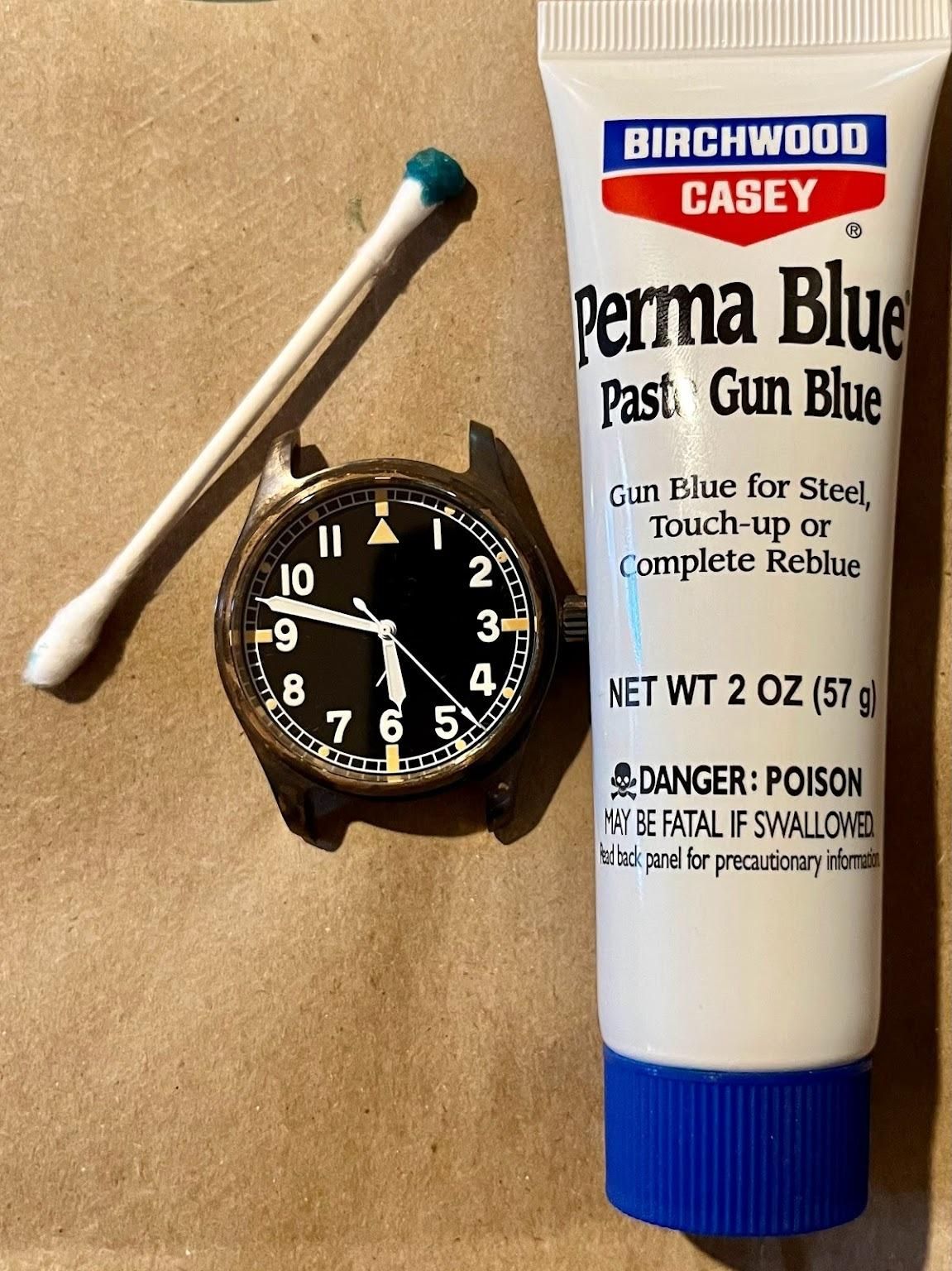
Bronze Watch Experiment #2: Plant Fertilizer


Recent Comments

I have a 42 mm Jazzmaster. The build quality is excellent, per details, fit, finish, and design. Hamilton today is a "remix" of Swatch family products, and I can see many similarities between it and family brands such as Tissot and Mido. They appear to take the same basic designs and create "USA" or "Italian" or "Traditional" looks through styling touches. It comes across to me as what GM did back in the day when restyling the same basic cars to be sold as Chevrolet, Buick, Oldsmobile, Pontiac, or Cadillac.
My brain likes the Jazzmaster but my heart not so much. It wears very large on my wrist, per substantial weight and thickness, a bulging and magnifying domed crystal, and undercut case that catches on things (the top flares out). If buying again I'd choose 40 mm instead.

Metal patina = corrosion.
I started this project because I found a wide range of naive commentary about expectations for the final appearance of bronze watches, and also limited awareness of how to create patinas. This is despite decades and centuries of metal finishing science and artistic experience. Watch hobbyists today don't seem to interact much with the arts and crafts crowd. Wearing a watch will expose it to sweat and salts, and this sends it down a predictable patina path based on how body chemicals interact with a specific bronze alloy. For example, CuSN8 bronze easily turns dark brown while aluminum bronze alloys (e.g., Tudor's current products) will remain much more yellowish.
A natural patina is often (1) very slow and smelly, (2) predictable, (3) disappointing to some when it results in a plain dingy/tarnished appearance, and (4) can continue past a desired end point. In contrast, a forced patina uses the established chemistry to rapidly reach a predictable and controlled outcome. If desired any patina can be coated to preserve the appearance (later experiments planned on my end).
I bought this watch to experiment, not to wait for some magical and personal patina to occur. I've been there and done that. Most of the time the outcome is plain and boring.
A reviewer who was disappointed and unhappy with a typical natural bronze patina:
https://www.youtube.com/watch?v=mUE9zs6KMBM
Examples of naive and clumsy forced watch patinas (these are NOT fully reversible):
https://deployant.com/the-bronzed-patina-the-curious-case-of-patina-how-to-get-it-and-how-not-to/
https://www.youtube.com/watch?v=P2ixqbnuGoU
Examples of the informed chemistry of patinas, even down to interactions with specific alloys:
https://exarc.net/issue-2017-2/ea/colour-palette-antique-bronzes-experimental-archaeology-project
https://www.sciencecompany.com/Patina-Formulas-for-Brass-Bronze-and-Copper.aspx
I have about the same size wrist. I've found that 37 mm to 43 mm watches work for me. Thickness is as much an issue as diameter, particularly if you wear long sleeves. For example, I have a flat/slim 43 mm watch that works with everything for size and comfort. In contrast, my smaller Casio G-Shock is super thick at about 15 mm high and has sharp edges on the top. I hate wearing it with long sleeves, even for sporting purpose. Winter jackets hang up and must be constantly readjusted.
Lug length plays a role, but if it doesn't stick over the edges of your wrist it'll be fine in my experience. Short lug watches do wear smaller. I have a 50 mm case watch with "longer" lugs and it's comically huge -- like a little kid wearing an adult watch. It's also thick and smashes into things easily.
Dive watches versus other designs: The rotating bezel of a dive watch is typically tall and square, making the watch chunky and feeling larger. You may or may not like that feel. However, the bezel can make the watch appear smaller than a same diameter full-face watch. I have 37 mm non-dive watch that appears larger on the wrist than some 38 to 40 mm dive watches. The appearance of size depends heavily on the particular watch design and color combination.
My advice: buy some inexpensive watches as size testers. These could be quartz or homages, but buy something you actually like and don't buy junk. Or, if you buy very cheap junk donate them to kids or charity.
The booming brands were all luxury products. They became investment items for the Bitcoin and tech stock crowd, and also benefited from the stimulus checks and low interest rates of the last couple years.
As bought/owned by middle and upper class people, I expect values to follow a real estate downturn pattern. This often involves stagnation and slow inching down, but not a rapid or extreme crash. The well-to-do own them and aren't under pressure to sell, so they'll sit on them and lose their investment value through inflation. The sticker prices could stagnate for 10 or 20 years, and some brands may go down and never come back.
All fashion items go in cycles and become faddish from time to time. First popular, then unpopular, then popular, etc.
EDIT: Track the price trends here
I bought this 50 mm Navitimer homage several years ago to see how big of a watch I could wear. The lugs hang over the edges of my wrist so this is too big for my taste. In addition, it's at least 15 to 16 mm thick and smashes into everything. I don't wear it at all. These days I shop for 42 or 43 mm watches at most, per my 7" or 180 mm wrist.

My scratched beater field watch is a Citizen Eco-Drive 37mm. I've travelled with this one using either a canvas or silicone strap, not leather as shown.

You are getting at the value of a watch as jewelry. Mechanically, a $200 to $500 Japanese/Chinese/Microbrand watch can look and feel an awful lot like at $10,000 Rolex. The Rolex will perhaps be more durable, but consider $20 to $100 Casio and G-Shock watches the standard for real-world durability.
Some of the jewelry cost of watches pertains to expensive metals, diamonds, sapphire cases, etc. A lot of the cost follows from leasing expensive boutiques, hiring expensive engineers, hiring persuasive sales staff, and running expensive ads. Many watchmakers are located in Switzerland, and it's one of the most expensive places to live in the world.
For assessing cost of production, check out the Watchfinder & Co plus Jenni Elle comparison videos of the Hong Kong master fakes (e.g., 10,000 Euro vs. 700 Euro). The fakers are so good that you must use a microscope and open the case to check the movement and serial number. Even the movements have fake facades. Panerai has run into trouble for not being able to identify its own genuine production pieces versus fakes.
Bottom line: Human senses start to fail certainly before $1,000US with mainstream Rolex-Omega-Breitling-type watches. Differences in details and finishing can generally be spotted either by eye or with a microscope. [Do you care?] Beyond that, prices follows from the cost of rare and exotic builds, metals, diamonds, and mostly marketing.