Mr. Tough Guy


The cog wheel shape of the Marathon SAR bezel is something that a few of us have come to appreciate for its tactile feel, but many more of us know and recognize because of its unique design. But how many of us noticed the unusual knurling of the crown?

What the macro lens revealed this morning is something that reminded me more of synchro wheels in a transmission gear rather than a watch crown.
It's also a good opportunity to notice how the crown guard is smoothed because it's a clever design on its own. The curves are there not only to protect the stem of the crown but also to direct the fingers to the crown. Anyone trying to pinch this area will discover how his fingers are automatically guided to the top of the crown.

The Marathon MSAR has plenty of smart things in its design, most of us know about the tritium tubes that provides an ever lasting illumination (at least for the next decade or so). However, how many of us noticed how incredibly legible is the dial? The choice of colors for the hands and the fonts used on the dial do an excellent job at creating a watch that is very usable despite being rather small (the MSAR is 36mm in diameter).
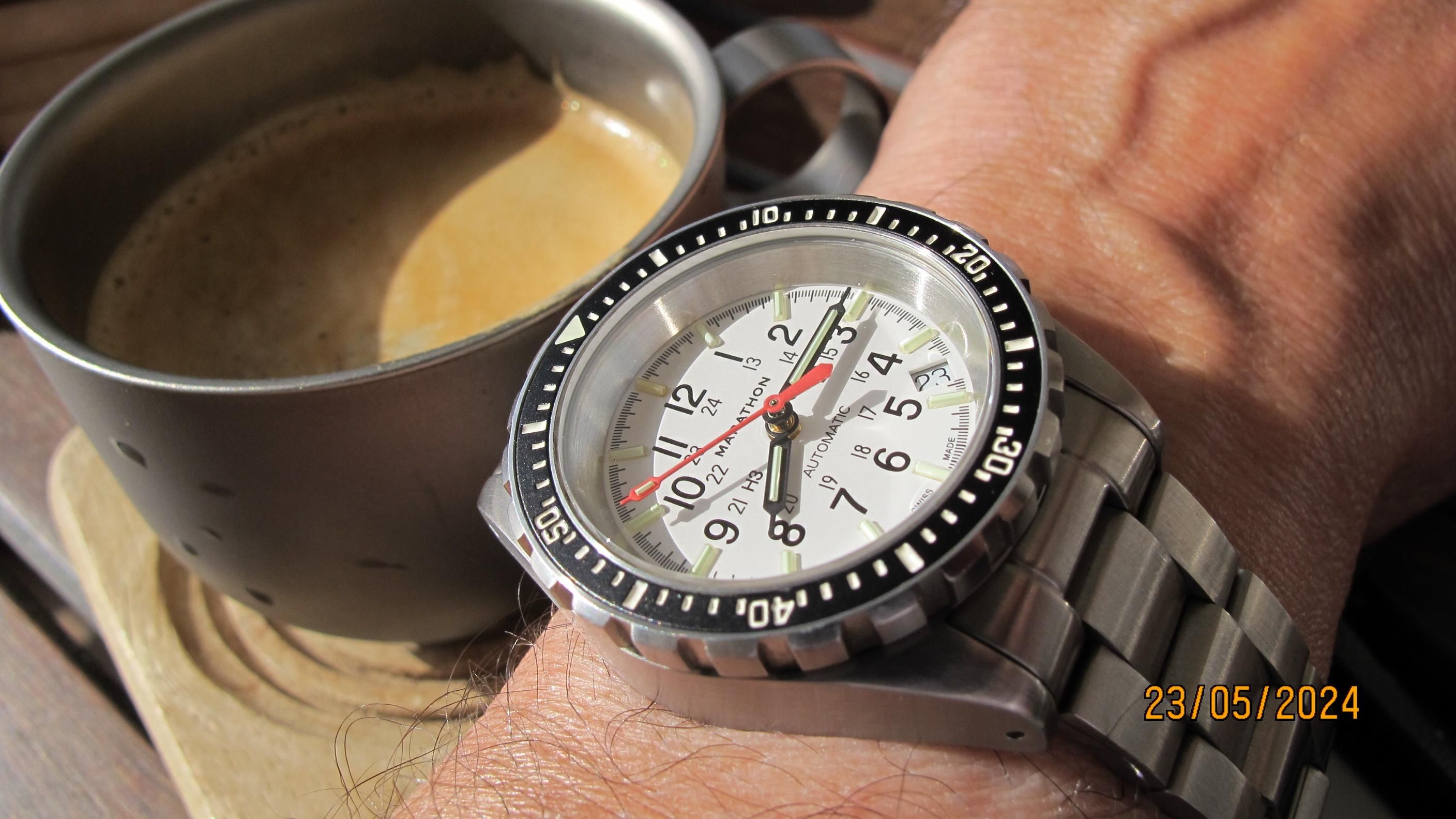
And it work! This morning the sun came up hard and fast, something which would turn most of my other watches into a glittery or hazy mess, but this is not a problem for the Marathon MSAR, and in view of it's overall toughness I doubt if there are many things that are problematic for it.

I'm a big fan of watches that are interesting because they are either unique, have interesting features, well designed or simply offer a great value for their price.



I think most owners of these become aware of the knurling on the crown the first time they wear the watch loose, lol. It is pretty aggressive, but it's extremely easy to grip, even with gloves.
I feel like people under-sell the longevity of tritium a lot of the time. The half-life is about 12 years, so it will be about half as bright after that, about a quarter as bright after 25, and about an eighth as bright after 37 years. Now I don't have any tritium tubes from 37 years ago, but tritium tubes start out pretty bright. This image is taken of my GSAR, which was probably built a couple years ago, and my new cwc diver, which has quite good lume. It's been about 8 hours since either of them saw even a light bulb turned on. I'm using a long exposure mode on my camera to even be able to see the CWC, but in the dark, I can still read it with my naked eye.
The tritium is way brighter, probably akin to the CWC after like 20 minutes of being in the dark. Another thing to keep in mind is that perceived brightness differences are said to be somewhere between a the square and cube root of measured brightness differences. Half of the tritium decaying is a measured brightness difference, essentially. If we take the square root side, it should appear about half as bright after two half lives, square root of 1/4 is 1/2. If you're generous and use the cube root, then it would take three half lives to seem half as bright, cube root of 1/8 is 1/2.
There could definitely be other things that affect this, like degradation of the phosphorescent compound used on the inside of the tubes, diminished clarity of the glass, etc. I just think the tritium discussion seems to overestimate the impact that the decaying itself will have, while underestimating how much our eyes can adjust to low light. Brand new, my tritium glows very strongly when it's actually dark enough to need it. It could glow a lot less intensely and still be more legible than regular lume in low light unless the lume was charged very well and very recently.
Our eyes are extremely good at adjusting light sensitivity. Even the full moon is hundreds of thousands of times less bright (measured brightness) than the sun, and you can see remarkably well in the full moon light. With things like gun sights and airplane instrument panels, I get why people want fresh tritium after a decade, but I think that it will serve time telling duty for quite some time for most of us.
IMO there's no real issue with tritium half life because a dial and handset can be changed during a service and it's not like the alternatives are any better. At least tritium tubes don't slowly disintegrate into crumbs inside the watch.
IMO there's no real issue with tritium half life because a dial and handset can be changed during a service and it's not like the alternatives are any better. At least tritium tubes don't slowly disintegrate into crumbs inside the watch.
I agree. I will gladly send my watch back in a few decades for a new dial from Marathon, even if it's still quite usable, just to reset the clock in case Marathon goes under or something. If that's the price I pay for bright, legible hands and indices all the time, no matter what, sign me up.