












Recent posts

A little window shopping in Orange County


Goodbye to an old friend - Sold my Chopard Mille Miglia Gran Turismo XL


Shadow Play


Recent Comments

Such a great watch. Had I not bought my Pelagos 39, I probably would’ve bought the Black Bay Pro instead. It’s peak “rugged yet sophisticated adventure travel watch”to me (yeah, over the Explorer II in my book; I just don’t like the Rolex maxi case design, or the bold font on the bezel, or the Mercedes hand).
I love my Pelagos 39. It’s exactly what you’re talking about - a supremely versatile and unobtrusive watch.
And the lume ❤

If I do pick up a pelagos I might wait for a good deal on a used one on rubber or a really good deal with the bracelet.
It comes with both in the box!
Not to be that guy - but I don’t agree with the premise of the price point question. The answer is both can be right at any price point.
Are printed indices “cheaper” than applied? Maybe? We really don’t understand how much things cost in watches (check out the Adrian Barker interview with the CEO of Fears - they spend more on the hands of the Brunswick than the movement). I wouldn’t necessarily say that high quality inks - you know the kind that can print crisply and last forever without fading - are significantly cheaper than tiny bits of stamped metal. You can get a full set of luminous markers for under a buck on Ali Express, after all. And while Farer spends a lot of money manually milling and blueing their hands, you can get a set of hands for 20¢ as well.
For printed vs applied text and markers, it really comes down to design choice. For these two watches here, no I don’t think you could get the look with indices:


Could you get close? Sure. But you’re looking at pretty delicate, thin indices that may look pretty cheap and which won’t carry much lume (not that the Mühle has much, but if you wanted an index the size of that lume plot, you’ll have even less). Oh, just make them thicker? Then it’s not the same look. When you’re talking about products that are measured in millimeters, a tenth of a mm can make a difference.
Also keep in mind that indices add height to a watch. Is it a lot? No, but the designers need to build in clearance, so at the very least, you’ll get more depth in the dial. Is that what you want as a designer?
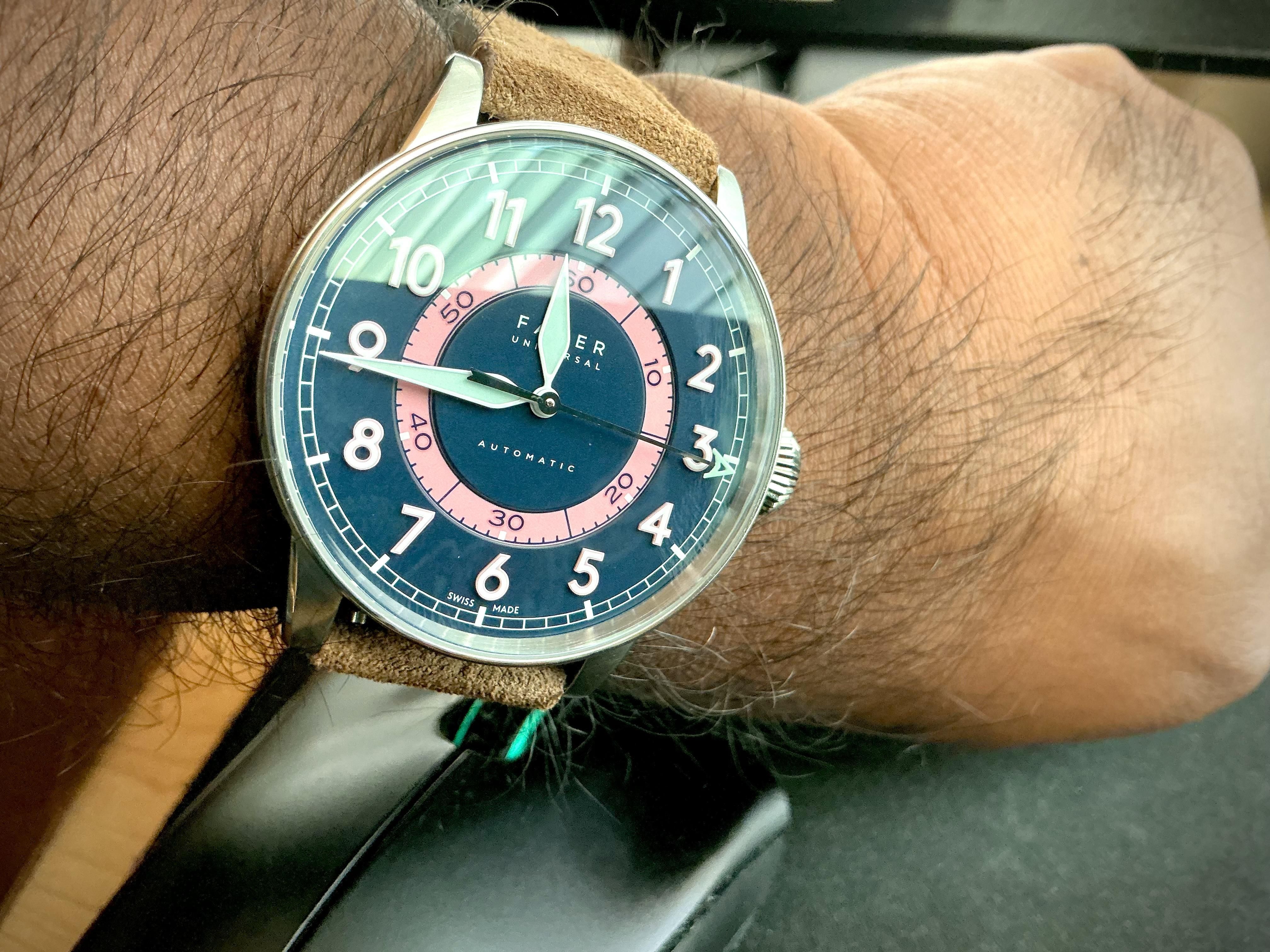
With the Mühle above, you get a graphic, flat look. Applied indices wouldn’t give that look. But for this Farer below, having printed hour markers wouldn’t work because the multilevel, multicolor depth that the indices give is a huge part of the design of the watch.
As far as I can tell, mostly everyone uses pad printing now, which - also, as far as I can tell - is the pinnacle of printing. That’s not just for watches, but across all manufacturing. Watch makers invented the process, and lots of other industries use it. Maybe multi-axis inkjet or laser printers will displace pad printers at some point, but the ability to do very intricate, sharp printing on all sorts of materials with relatively simple machines is still awesome.
If there’s an advancement, it’ll probably have to do with better inks (which may or may not be more expensive!).
But with your wife's consent haha
That should go without saying, it’s a basic rule of life for everything 😉
That’s true for a lot of things in life. You’ll see people who can afford much more expensive cars buying Miatas for that very reason - they just like it better.
It takes a bit of maturity and self awareness to look at a situation and say: i can spend more, but I’m not going to be any happier, so I’m not going to bother.
And with watches, because of the how good the lower priced product has become (and how much variety of it there is now), it’s easier and easier to pass on the expensive stuff in favor of something much less expensive but very good in their own right and their own way.
More posts
Slow Mo Guys’ Macro Slow Motion Video of A Watch Movement


Field Watch Doing Field Watch Things


Predictions & Wishcasts for 2025


The RETURN of About Effing Time!


Seiko SBSA 281: Now this is a WEIRD Collaboration


A Watches In The Wild Takeover




