Seiko Cronos
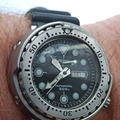

Hello, good evening (wherever they are). I would like to get clarification on a point of detail that can be seen on the dial of this watch. Indeed, there is a star at 6 o'clock and, despite many unsuccessful searches, I no longer remember the exact meaning of this little thing. I think it concerns the material (gold) which is on the indexes but I am not sure. If a Seiko specialist could enlighten me. Thank you in advance and happy new year to all. Fabrice.😅😁
2 comments
Sort by

Fabrice
I am mainly a fan of Seiko but I like other brands.😜
Member since
Last active: 2 years ago
8.46”
/
21.50 cm



I found the answer to my question by searching for the same watch model on C24.😅😅
extract from a post of mine …
The watches were offered with a variety of nuanced dial options and these were designated by the little symbols on the dial just above the six o’clock position. The variations in the symbols were themselves pretty subtle and it feels as though you need to be initiated into some secret society in order to decode them! These symbols were dropped in the mid-1960s when Seiko’s reference numbering became a bit more sophisticated and able to distinguish the variants. Also around that time, Seiko began producing extensive catalogues, which does make research just a little easier (but not a lot if you don’t read Japanese).
The dial main symbols for higher-end Seiko watches were as follows.
And here’s what they meant:
SD (Special Dial) - solid gold applied indices for gold or gold-plated cases and white gold applied indices for stainless steel cases.
AD (Applique Dial) - hard gold-plated (referred to as SGP or strong gold plated by Seiko) indices for gold or gold-plated cases and rhodium-plated indices for stainless steel cases.
ED (Extra Dial) - normal gold-plated indices for gold or gold-plated cases and nickel-plated indices for stainless steel cases.
All the SD dials had the indices manually fitted to the dial with pins that planted them in fixing points on the dial.
All the ED dials just had the indices glued to the surface of the dial.
And for the AD dials, many had the planted indices but some had them just glued.
The higher levels of dials commanded a premium when these watches were being sold new but, as the knowledge of these subtleties has receded, those price differences aren’t consistently reflected in the current pricing of these vintage watches.
Seiko continued manually setting planted indices on some of its higher end watches into the 1980s while many other manufacturers had moved away from this labour-intensive approach much much earlier.